As an Amazon Associate we earn from qualifying purchases. Prices and availability are accurate as of the date shown and are subject to change.
Shopping for the best electric chapati maker is tricky because most models are tortilla presses with a roti label. Here is what owners actually praise, what breaks, and which of nine options suits you.
The 60-second summary: first we rank all nine models. Next, the quick picks show our top three. After that, the comparison notes explain how the categories differ, and the buying guide covers what first-timers should check. Finally, the FAQ answers common questions. If you only want the short version, jump to the quick picks.
Choosing the best electric chapati maker is harder than it looks. Most dedicated presses on this list are rated between 3.0 and 3.5 stars, and owners repeatedly mention weak heat, sliding dough and handles that break. The better-reviewed options are actually large griddles or saj-style domes that work with dough you roll yourself.
We weighed specs, price tier and owner sentiment for each pick. This guide comes from muslimrestaurant.com, and we kept the cons as visible as the pros so you can buy with realistic expectations.
Key Takeaways
- Dedicated presses score lower: The press-style roti makers here sit at roughly 3.0 to 3.5 stars across thousands of reviews, so expect to manage some trade-offs.
- Durability is the common complaint: Broken handles, plastic parts that crack and units that stop heating come up repeatedly in owner feedback on the presses.
- Griddles earn happier owners: The large ceramic griddle has the strongest sentiment, but you roll and flip each chapati yourself.
- Voltage and size matter: Check for 120V US operation and a plate size that matches the chapatis you usually make.
- Thin review data needs caution: Several newer listings have only a handful of reviews, so their ratings are an early signal, not proof.
Our Top Picks for Electric Chapati Maker
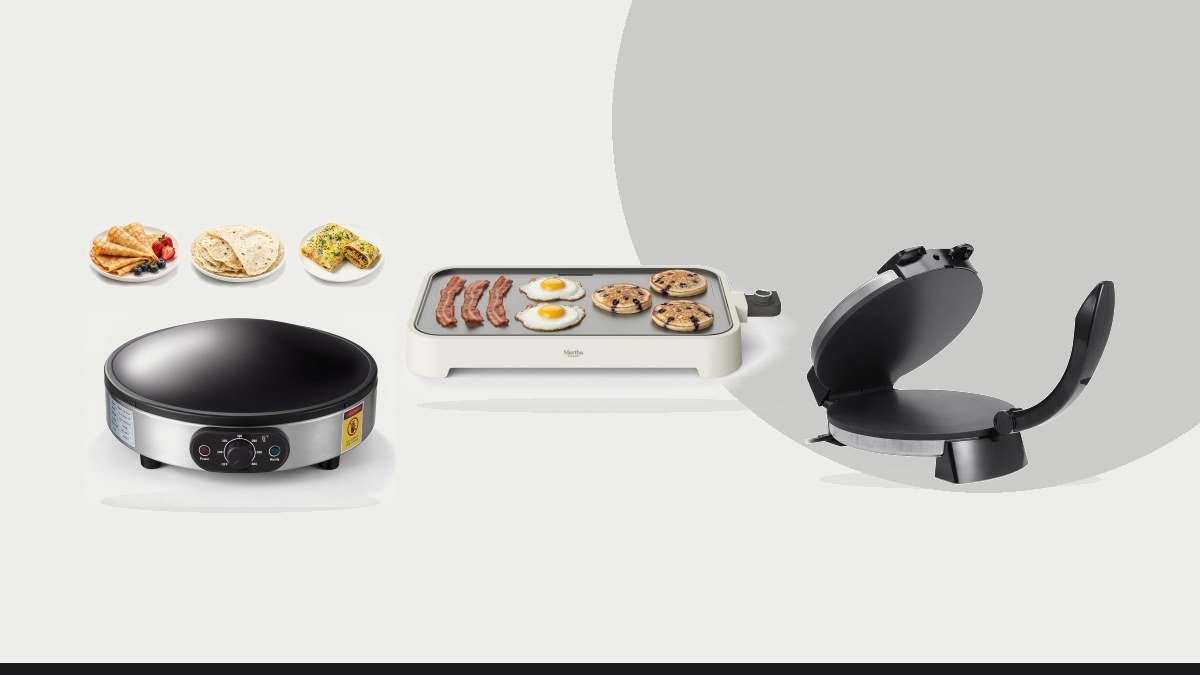
- Best Overall: Martha Stewart XL Griddle – the happiest owners, fast even heat and a huge ceramic surface for rolled chapatis.
- Best for Large Flatbreads: SuYiFan 16-Inch Saj Maker – a wide convex dome with adjustable heat, though reviews are still very few.
- Best Budget: BJLIFE 10-Inch Roti Maker – the lowest-cost press with a 10-inch plate and temperature knob, but little owner history.


Prices as of October 29, 2026
The Best Electric Chapati Maker: Reviewed
1. Martha Stewart 12×22 XL Electric Griddle: Happiest Owners
Verdict: The strongest owner sentiment on this list, with fast even heat and a roomy ceramic surface. It is a griddle, not a press, so you roll your own chapatis.
This is the odd one out, and it still wins. Instead of pressing dough, you roll chapatis by hand and cook them on a 22 by 12 inch flat surface. That suits anyone who already rolls dough and wants a reliable, fast-heating cooktop on the counter.
The embedded heating element, 1500 watt rating and dial control go up to 400°F. Owners describe even heating and quick warm-up, and the PFAS-free ceramic nonstick surface gets repeated praise for easy release. The size lets you cook several items at once, which helps when feeding a family.
Cleanup is simpler than most presses: the griddle and drip tray are dishwasher safe once you detach the temperature probe. The trade-off is footprint. At about 25 inches deep, it needs real counter or storage space.
It will not puff or flatten dough for you, so beginners wanting a one-step machine may prefer a press. With only 246 reviews, it also has a shorter track record than some rivals.
What Owners Say
Owners call it one of their best kitchen purchases, praising even heating, quick temperature rise, the large size, the nonstick ceramic surface and the temperature control. We found no recurring complaints in the supplied feedback, though the review count is modest.
| Pros | Cons |
|---|---|
| Strongest owner sentiment of the nine | Not a press, so you roll and flip by hand |
| Fast, even heating | Bulky at roughly 25 inches deep |
| Large 22 x 12 inch surface cooks several pieces | Only 246 reviews so far |
| Ceramic nonstick releases easily | Premium-tier price for a griddle |
| Griddle and drip tray are dishwasher safe |
Best for: Cooks who roll their own chapatis and want a big, even heating surface. Not for: Beginners who want a machine to flatten and cook dough automatically.
Specifications
2. SuYiFan 16-Inch Saj Maker: Big Dome for Thin Breads
Verdict: A 1600W convex griddle with wide temperature range that suits thin, large flatbreads. Promising rating, but only seven reviews.
Saj makers use a curved dome, and this 16-inch version is built for thin dough you stretch or roll out. It lists chapati and roti alongside saj, lavash and tortillas, so it fits households that cook a mix of flatbreads.
The 1600 watt element and 200°F to 460°F dial give wide control, and red Power and green Ready lights show when to start. A nonstick plate and stainless housing round out the design. At 6.6 pounds, it is sturdy without being unwieldy.
The caveat is evidence. The 4.6 rating rests on just seven reviews, and no owner sentiment summary is available, so durability and heat consistency are unproven. Warranty details also differ within the listing (one year in the specs, two years elsewhere), so confirm before buying.
It sits in the premium tier, and at nearly 18 inches square it needs space. If you want large, thin breads rather than small pressed rounds, it is the most interesting option here.
What Owners Say
There is not enough owner feedback yet to identify patterns. The few ratings are positive, but treat that as an early signal rather than proof of long-term reliability.
| Pros | Cons |
|---|---|
| Large 16-inch convex nonstick surface | Only seven reviews, so reliability is unproven |
| 1600W with 200 to 460°F adjustable heat | Warranty length is inconsistent in the listing |
| Power and Ready indicator lights | Premium-tier price |
| Handles several flatbread styles | Takes up nearly 18 inches of counter |
Best for: Households making large, thin flatbreads like saj or lavash alongside chapati. Not for: Buyers who want a press that flattens dough for them.
Specifications
3. BJLIFE 10-Inch Roti Maker: Lowest-Cost Press
Verdict: A budget press with a 10-inch plate, temperature knob and detachable handle. Very few reviews, so go in with measured expectations.
This is the lowest-priced model in the roundup, and it still offers a 10-inch plate, which is larger than several pricier 8-inch rivals. A 1100 watt element, a temperature knob and red and green indicator lights cover the basics.
The detachable handle and ergonomic design are meant to simplify storage, and the maker promises a quiet, wipe-clean surface. At about 5.5 pounds, it is heavier than the Brentwoods, which can suggest sturdier construction, though that is only an interpretation.
The big caveat is the lack of evidence. Five reviews average 3.8 stars, and there is no owner sentiment summary, so we cannot confirm heat consistency or durability. The listing also leans on crepe language in places, and it does not specify the plate material.
If you want to try an electric press without spending much, it is a reasonable gamble. Just keep the return window in mind and check that the first few rotis cook through evenly.
What Owners Say
Too few reviews exist to describe consistent praise or complaints. The small sample is lukewarm to positive, so treat claims about quick, even heating as the maker’s description rather than confirmed owner experience.
| Pros | Cons |
|---|---|
| Lowest price tier of the nine | Only five reviews, so reliability is unknown |
| 10-inch plate is larger than the 8-inch models | No owner sentiment data |
| Temperature knob with indicator lights | Listing lacks detail on plate coating and warranty |
| Detachable handle for storage | Rating of 3.8 is not a strong endorsement |
Best for: First-timers who want a low-risk, low-cost way to try an electric press. Not for: Anyone who needs proven long-term durability.
Specifications
4. Brentwood TS-127 8-Inch: Simple and Familiar
Verdict: A straightforward 8-inch press that owners find easy to use, but handle breakage and uneven heat are recurring complaints.
The TS-127 is a compact 1000 watt press with an 8-inch plate, adjustable heat and power and preheat indicator lights. The listing explicitly mentions chapatti and roti, and at 2.6 pounds it is easy to stash in a cupboard.
Owners say it is simple to use and cooks rotis, parathas and tortillas acceptably. The non-stick aluminum plates are meant to wipe clean easily, and the heat dial lets you choose softer or crispier results.
The 3.5 rating across more than 2,800 reviews, though, reflects real problems. Some owners report the handle breaking right off, dough sliding out during pressing, and heat that is either fine or not warm enough. Several also feel it is not worth the purchase.
It is an affordable, mid-tier entry that works for light use. If you plan to make chapatis daily, durability concerns should give you pause, and the one-year warranty is worth registering.
What Owners Say
Owners praise how simple it is to use and its cooking results for rotis, parathas and tortillas. Complaints are consistent too: handles that break, dough that slides out, mixed views on heat, and a sense that it is not worth the money.
| Pros | Cons |
|---|---|
| Simple, beginner-friendly operation | Handle reported to break right off |
| Cooks rotis, parathas and tortillas for many owners | Dough can slide out during use |
| Adjustable heat and indicator lights | Heating is inconsistent for some owners |
| Light at 2.6 pounds and compact | Only an 8-inch plate |
| Many owners say it is not worth the price |
Best for: Occasional users wanting a small, easy press. Not for: Daily heavy use or large chapatis.
Specifications
5. Brentwood TS-128 10-Inch: Bigger Plate, Same Risks
Verdict: Offers a 10-inch plate and six browning settings, but owner feedback flags plastic breakage and unreliable heat.
The TS-128 steps up to a 10-inch plate and 1200 watts, with a six-setting browning dial, cool-touch handle and power and ready lights. The brushed stainless finish looks tidy on a counter, and 3.7 pounds is still manageable.
On paper, it solves the main limitation of the smaller Brentwood. A bigger plate gives you chapati-sized rounds rather than tortilla-sized ones, and the six settings should help you dial in softness.
Owner feedback is more cautious. Experiences with function are mixed: some say it heats just right and cooks tortillas well, while others say it does not heat at all. Several report plastic parts breaking under pressure, dough sliding around and trouble getting it flat.
With a 3.4 rating from more than 2,800 reviews, the pattern is clear. It can work, but quality control seems uneven. It lands in the budget-to-mid tier, so the risk is limited, but it is not a confident buy.
What Owners Say
Owners who are happy say it heats up well and cooks tortillas nicely. The recurring complaints are plastic breaking under pressure, dough sliding and not flattening properly, units that do not heat, and doubts about value for money.
| Pros | Cons |
|---|---|
| 10-inch plate for larger rounds | Plastic reported to break under pressure |
| Six-setting browning control | Some units do not heat up |
| Cool-touch handle and indicator lights | Dough slides and is hard to flatten |
| Works well for some owners | Many owners question the value |
Best for: Shoppers who want a bigger plate and accept some quality-control risk. Not for: Buyers who need a dependable daily workhorse.
Specifications
6. StarBlue 10-Inch Roti Maker: Warmer Included
Verdict: Comes with a roti warmer, removable handle and six settings, but mixed cooking results and durability worries hold it back.
StarBlue gives you the most accessories here: a 10-inch non-stick press, a free roti warmer with its own temperature knob, a removable handle, skid-resistant feet and cord storage. The 1200 watt, six-setting design also lists BPA, PFOA and PTFE free.
Some owners say it saves time and energy, and that rotis puff up nicely. That is the outcome most shoppers want, and it explains why this one has a large following of over 3,000 reviews.
The downsides are significant. Feedback on functionality is mixed, with some saying it never works properly or leaves rotis undercooked. Others report it breaks after limited use, and heat distribution is described as inconsistent. Owners also disagree on whether rotis come out soft or thick.
The listed warranty is only two months, which is short for a premium-tier price. At 4.4 pounds, it is also heavier than most. The warmer is a nice bonus, but it does not offset reliability concerns.
What Owners Say
Owners like that it saves time and that rotis puff up well. Common complaints include breaking after limited use, inconsistent heat, undercooked rotis, and disagreement on softness and thickness.
| Pros | Cons |
|---|---|
| Free roti warmer with temperature knob | Reported to break after limited use |
| Rotis puff nicely for happy owners | Inconsistent heat distribution |
| Removable handle and cord wrap | Some rotis come out undercooked |
| Six temperature settings | Only a two-month warranty listed |
| Premium-tier price for a 3.2 rating |
Best for: Shoppers who value a bundled warmer and are comfortable with some risk. Not for: Anyone who needs dependable long-term performance.
Specifications
7. Westinghouse WKRM293: Compact Roti Press
Verdict: A compact 8-inch press from a known name with five heat settings, though it has just 12 reviews and a middling rating.
Westinghouse offers an 8-inch non-stick press with 1000 watts, five temperature settings and red and green indicator lights. The stainless housing and 3-pound weight make it a reasonable fit for a small kitchen.
The listing is clear about its purpose: rotis and tortillas that stay in one piece thanks to the non-stick surface. Cleaning is a wipe with a slightly damp cloth, which is simple but means no soaking.
Evidence is thin. A 3.2 rating from 12 reviews gives us no owner sentiment summary, so we cannot say whether heat or durability are strong or weak. The warranty is described only as limited, and the availability field was blank at the time of the data.
It is a mid-tier choice that duplicates what the Brentwood TS-127 offers, with fewer proven results. Unless you find it at a clearly lower price, the better-documented alternatives are safer.
What Owners Say
There are too few reviews to find reliable patterns. The 3.2 average from a small sample suggests mixed satisfaction, but we cannot name specific praise or complaints.
| Pros | Cons |
|---|---|
| Five temperature settings | Only 12 reviews and a 3.2 rating |
| Power and ready indicator lights | No owner sentiment data |
| Compact and about 3 pounds | Limited warranty with unclear terms |
| Recognizable brand name | 8-inch plate limits chapati size |
Best for: Small kitchens wanting a compact 8-inch press. Not for: Shoppers who want a proven, well-reviewed model.
Specifications
8. Libra Roti Maker: Mixed Quality, Stock Issues
Verdict: Owners say it performs well, yet quality feedback is split and value is questioned. The listing is also confusing about voltage and was out of stock.
Libra markets this as an 8.5-inch non-stick press with automatic temperature control, cool-touch handles, non-slip feet and automatic shut-off. It lists 950 watts and says it can handle rotis, dosas, pancakes and sandwiches.
Some owners say it performs well. However, quality feedback is split: a few call it exceptional while others call it rubbish, and several say it is not worth the price. That wide gap suggests inconsistent units.
The listing also raises flags. The specs show 230 volts, while the title mentions a 110V UL-certified plug. For a US kitchen, confirm which version you are buying before ordering. Availability was listed as temporarily out of stock, and the price sits in the premium tier.
With a 3.0 rating from over 2,000 reviews, it is the lowest-rated press with a meaningful sample. It is hard to recommend over cheaper, similar options.
What Owners Say
Owners who like it say it performs well. Mixed quality comments, from exceptional to rubbish, and repeated doubts about value for money, are the main pattern.
| Pros | Cons |
|---|---|
| Reported to perform well by satisfied owners | Quality feedback is highly inconsistent |
| Auto temperature control and shut-off | Owners question value for the price |
| Cool-touch handles and non-slip feet | Voltage details in listing conflict |
| Compact and lightweight | Temporarily out of stock at the time of data |
| Lowest rating among well-reviewed presses |
Best for: Shoppers who find it in stock and confirm the 110V version. Not for: Value-focused buyers or anyone wary of inconsistent quality.
Specifications
9. Generic Automatic Roti Maker: Unverified Claims
Verdict: Bold claims of AI dough handling and 20 pieces at once, but a 1.0 rating, no price, no reviews and thin specs make it risky.
This listing promises a fully automatic machine that measures, mixes and kneads dough, then cooks up to 20 rotis in 120 seconds. It also mentions a touch panel with thickness control from 1.0 to 1.5 mm.
Those claims do not line up with the supplied data. The specs list a package size of 3.15 inches per side and a weight of 2.2 pounds, which hardly fits a kneading, dispensing machine. The text also references another brand’s name, a sign of careless copy.
There is no price, no review count, no wattage or voltage, and a 1.0 rating. No owner feedback was available, so nothing supports the performance claims.
If you want an automatic roti machine, research established dedicated brands. We cannot recommend this listing based on the information provided.
What Owners Say
No owner feedback summary exists, and the 1.0 rating has no review count behind it. We cannot identify any praise, and the missing data is itself the main concern.
| Pros | Cons |
|---|---|
| Ambitious feature list if claims were accurate | 1.0 rating with no verified reviews |
| Touch panel with thickness options described | No price, wattage or voltage listed |
| Specs conflict with the automatic claims | |
| Copy references another brand's product |
Best for: Nobody based on the current information. Not for: Anyone expecting a proven automatic roti machine.
Specifications
How They Compare
The nine products fall into three groups. The first is griddles and domes (Martha Stewart, SuYiFan), which have the best sentiment or ratings but require you to roll dough yourself. The second is presses (Brentwood x2, StarBlue, Libra, Westinghouse, BJLIFE), which flatten and cook dough but get mixed reviews on heat and durability. The third is the unverified automatic listing, which we would skip.
Plate size is the easiest dividing line: 8-inch presses suit tortillas and small rotis, while the 10-inch models give you proper chapati diameter. Warranty also varies from two months to one year, so it is worth factoring into the decision.
What to Look for in Electric Chapati Maker
Plate size
The plate decides the largest chapati you can make.
Look for: 10 inches for standard chapatis; 8 inches only for small rotis or tortillas.
Avoid: Assuming an 8-inch press makes full-size chapatis.
Heat control and power
Even, adjustable heat is what puffs a roti instead of leaving it pale.
Look for: 1000 watts or more, a temperature dial and a ready light.
Avoid: Models where owners repeatedly say they never get hot enough.
Build and handle
Handles and plastic parts are where owners report failures.
Look for: Metal housing, a sturdy handle and a clear warranty.
Avoid: Plastic parts reported to crack under pressure.
Voltage and listing clarity
Mismatched voltage or missing specs signal risk.
Look for: 120V US rating and complete specs.
Avoid: Listings with conflicting voltage or no wattage.
Cleaning and storage
A bulky or hard-to-clean unit gets used less.
Look for: Non-stick plates, cord wrap or detachable handle.
Avoid: Large units if your cupboard space is limited.
Electric Chapati Maker Buying Guide
What the best electric chapati maker actually does
Most electric chapati makers are heated presses. You place a dough ball between two non-stick plates, press down, and the machine flattens and cooks it. You then finish the roti on a stove if you want it to puff. Griddles and saj domes skip the pressing and cook rolled dough directly.
Pick the plate size first
An 8-inch plate gives you tortilla-sized rounds. If your family eats standard chapatis, look at 10-inch models. For large lavash or saj, a 16-inch dome is the better fit. Size also affects storage, so measure your cabinet.
Check heat and build before features
Warmers, removable handles and cord wraps are nice, but owners complain mostly about weak heat, sliding dough and broken handles. Prioritize 1000 watts or more, adjustable temperature and sturdy construction. A longer warranty is a useful tie-breaker.
Set realistic expectations
Even good presses take practice. Dough that is too dry or too wet is a frequent source of frustration. Start with soft, rested dough, lightly oil the plates if needed, and expect a few failed attempts. If you want guaranteed puffing without effort, a stove-top finish remains the traditional approach.
Confirm voltage and return terms
US kitchens use 120V. Skip any listing with conflicting voltage or missing wattage, and check the return window so you can send back a unit that does not heat.
How We Picked
We compared each product’s listed specs, features and price tier, then weighed them against Amazon’s owner sentiment summaries where they existed. Recurring complaints, such as broken handles or weak heat, counted heavily, particularly on models with thousands of reviews.
We did not run lab tests or cook with these machines. Where a product had only a handful of reviews, we lowered confidence and said so. Value reflects how the price tier compares with the features and track record.
Frequently Asked Questions
Is an electric chapati maker worth it?
It can be if you make flatbreads often and want consistent round shapes with less effort. However, owner reviews of most presses are mixed on heat and durability, so choose carefully and keep your expectations realistic. If you cook occasionally, a regular skillet may serve you just as well.
Can I use a tortilla maker for chapati?
Often yes. Several listings here are sold as tortilla makers but also mention chapati and roti. The main differences are plate size and heat. Choose a 10-inch plate if you want standard chapati diameter, and use soft, well-rested dough so it flattens evenly.
Why does my roti maker not get hot enough?
Some owners of the presses reviewed here report weak or inconsistent heat. Allow the ready light to turn on before cooking, use the highest suitable setting, and avoid cold, wet dough. If the unit still stays lukewarm, it may be defective and worth returning under warranty.
Do I still need to roll the dough?
With a press, no: it flattens the dough ball for you. With a griddle or saj maker, yes, you roll the dough yourself and cook it on the surface. The automatic machine listing claims to knead and cook for you, but we could not verify those claims.
How do I clean a non-stick roti maker?
Unplug it and let it cool first. Then wipe the plates with a slightly damp cloth, as makers like Westinghouse recommend. Avoid abrasive scrubbers that damage the coating. The Martha Stewart griddle is the exception: its griddle and drip tray are dishwasher safe once the temperature probe is removed.
Final Thoughts
The best electric chapati maker for most people is the one with proven heat and a sturdy build. Right now, that means a griddle or a carefully chosen 10-inch press. Check plate size, voltage and warranty before you buy, and revisit reviews as newer models gather feedback.
- Martha Stewart griddle has the strongest owner sentiment
- Most presses suffer from heat and durability complaints
- Avoid the unverified automatic listing
If you want the best electric chapati maker with the least regret, start with the griddle or the saj maker, then consider the budget BJLIFE press as a low-risk trial. Whichever you choose, check the return window. Thanks for reading from muslimrestaurant.com.