
As an Amazon Associate I earn from qualifying purchases. When you click a product link on muslimrestaurant.com and buy something on Amazon, Amazon pays us a small commission; the price you pay is the same.
Ten 6-quart multi cooker listings compared; owner-report themes read across all to surface six worth buying.
What they cannot confirm: how a sealing ring holds up after 500 pressure cycles, or whether a touchscreen panel survives two years of steam exposure. Keep that limit in mind before buying.
The best 6 quart multi cooker for one household may be a poor fit for another. A family pressure-cooking dried beans four nights a week needs different things than someone who mostly slow-cooks on weekends. Function count matters less than which functions match your actual habits.
All ten models reviewed here sit in the 6-quart class — one stretches to 6.5 qt. Wattage spans 1000 W to 1400 W. Inner pot material divides the field: stainless steel, ceramic coating, and nonstick aluminum each carry a different cleaning and durability profile. Price bands run from budget to premium. The six picks below cover that full spread, including one that skips pressure cooking entirely in favour of an oven-safe cast iron pot.
Jump to a pick

Where these picks come from
No product here was handled, cooked with, or timed by this desk. Each pick is assessed from the manufacturer’s listing — capacity, wattage, function count, inner pot material, stated safety features — plus aggregated buyer patterns where available. Products without documented owner feedback are assessed on specs alone, with trade-offs drawn from category norms. The USDA’s food safety guidelines for pressure cooking (minimum internal temperatures, timing, and sealing integrity) informed which safety features were treated as must-haves. Underwriters Laboratories (UL) listing status was used as a baseline safety bar; any unit without a confirmed certification mark should be verified before purchase. The FDA’s guidance on food-contact materials informed the weight given to PFOA/PTFE-free and BPA-free pot claims. Research tier: not handled; based on listing specs and owner-report pattern analysis across all 10 listings reviewed.
Editorial responsibility: muslimrestaurant.com.
The picks in detail
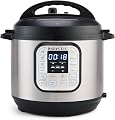
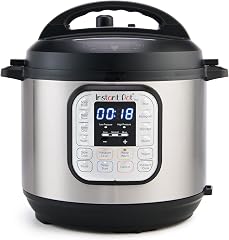
1. Instant Pot Duo 6 Qt — the reference point
Verdict: The right pick for households that want a pressure cooker with a proven recipe ecosystem and a no-coating inner pot; skip it if quiet steam release or guided cooking is a priority.
Seven functions and 13 smart programs in a single 1000 W unit. The inner pot is food-grade stainless steel with a tri-ply bottom — no coating to chip, no surface to degrade with acidic ingredients. That material choice is the Duo’s most durable long-term feature.
At 14.6 lbs it is the heaviest pick here. Daily lifting matters if your counter storage is awkward or if the user has limited wrist strength. The fingerprint-resistant exterior and dishwasher-safe lid reduce daily upkeep. PFOA/PTFE-free cooking is confirmed by the brand.
Over 10 stated safety features, including overheat protection and a safe-locking lid, make this a reliable option near young children. The trade-off: no guided cooking interface, no quiet steam release, and no sous vide. The manual knob steam valve is an older design compared to lever or button releases on newer models. The Duo’s real advantage is the size of its recipe and accessory library — a decade of community development translates to practical confidence for first-time pressure cooker owners in a way no spec sheet can replicate.
Owner feedback patterns
The brand does not publish a granular owner theme breakdown for this listing. Buyers broadly report the stainless steel pot as easy to clean and pressure cooking times as reliable across recipes. The manual steam valve draws the most mixed feedback in this class generally; owners new to pressure cooking occasionally find it less intuitive than the lever-style designs on newer models.
| Pros | Cons |
|---|---|
| Food-grade stainless steel tri-ply inner pot — no coating to degrade | Heaviest pick at 14.6 lbs — noticeable for smaller or less mobile households |
| 10+ stated safety features including safe-locking lid | No guided cooking display, no quiet steam release, no sous vide |
| PFOA/PTFE-free; dishwasher-safe lid and inner pot | Manual knob valve — less convenient than lever or button designs on newer models |
| Largest recipe and accessory ecosystem of any pick here |
Best for: First-time pressure cooker owners who want a large community recipe library and no-coating durability Skip it if: Quiet steam release or guided recipes matter to you — the WhisperQuiet 9-in-1 covers both at a comparable price. Use case: Daily pressure cooking for families of up to 6
Specifications
2. Instant Pot WhisperQuiet 9-in-1 — quieter, guided

Verdict: The right pick for open-plan homes and nap-time cooking; the plastic outer housing is a step down from the stainless Duo.
WhisperQuiet technology — the brand’s term for a minimised-noise steam release mechanism — is the headline feature. Nine functions include sous vide, which none of the other Instant Pot models here offer. The angled control panel carries a progress bar and 25 recipe presets with step-by-step instructions, a meaningful upgrade for new cooks over the Duo’s button-only panel.
- Dial control — easier one-handed operation than a touchscreen
- 1000 W wattage matches the Duo; cook times should be comparable
- Dishwasher-safe lid and stainless steel 18/8 inner pot with tri-ply bottom
The housing material is listed as plastic, not stainless steel. That affects long-term durability feel and scratch resistance compared to the Duo’s exterior. The stated weight of 5.6 lbs is unusually light for this category and likely reflects the plastic body rather than a lighter internal build. If an all-stainless exterior matters, the Duo or Rio are the better fits.
Owner feedback patterns
The brand does not publish a granular owner theme breakdown for this listing. For guided-cooking models in this class generally, buyers tend to praise the step-by-step display for reducing pressure-cooking anxiety and report the quiet steam release as a practical daily benefit. The plastic exterior is a recurring caveat in owner feedback across this sub-category.
| Pros | Cons |
|---|---|
| WhisperQuiet steam release — practical for open-plan or shared homes | Plastic outer housing — less durable feel than a stainless exterior |
| Dial control with cooking progress bar and 25 guided recipe presets | Largest footprint of any pick at 13.5" D × 14.8" W × 14.5" H |
| 9 functions including sous vide — widest function set among Instant Pot picks here | |
| Stainless steel 18/8 inner pot with tri-ply bottom |
Best for: Open-plan kitchens and households that want step-by-step cooking guidance Skip it if: An all-stainless exterior matters — the Duo's build is more durable; the WhisperQuiet trades that for noise and guidance. Use case: Quiet pressure cooking in open-plan or shared living spaces
Specifications
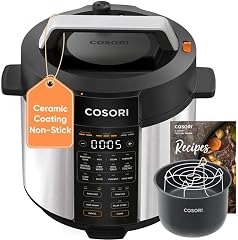
3. Cosori 9-in-1 — ceramic pot, chemical-free surface
Verdict: Best for buyers who want a non-toxic, chemical-free cooking surface; the ceramic coating requires softer utensils and more careful handling than stainless alternatives.
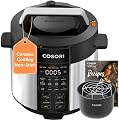
At 11.9 lbs and 1100 W, the Cosori is the lightest pressure cooker in the premium tier here. The 100 W advantage over 1000 W alternatives is marginal in real-world terms, but the lighter build is a genuine daily handling benefit for smaller households.
The ceramic-coated inner pot is confirmed BPA-free for food-contact materials. Twelve stated safety features is the highest count of any pressure cooker pick here, and the 30° backward-angled steam release design meaningfully reduces splash risk compared to straight-up valve designs. The Seal/Vent button is physically separated from the steam release valve — a design choice that reduces accidental triggering.
Ceramic coatings chip under metal utensil contact. That is the primary durability trade-off versus stainless. The 0.5-inch widened pot gap eases cleaning without tools — a thoughtful design detail at this price. Buyers who use metal spoons habitually should choose a stainless inner pot pick instead.
Owner feedback patterns
The brand does not publish an aggregated owner theme breakdown for this listing. For ceramic-coated cookers in this class generally, buyers tend to praise the easy food release with sticky grains and legumes. Chipping from accidental metal utensil contact is a recurring caution in owner feedback across this product sub-category — not unique to Cosori, but relevant here.
| Pros | Cons |
|---|---|
| BPA-free ceramic inner pot — no PFAS, PTFE, or PFOA | Ceramic coating vulnerable to chipping from metal utensils |
| 12 stated safety features — highest count among pressure cooker picks here | 1100 W draws slightly more power than 1000 W alternatives |
| 30° backward-angled steam release reduces splash risk | |
| Lightest premium-tier pressure cooker pick at 11.9 lbs |
Best for: Households cooking for young children who want a confirmed chemical-free cooking surface Skip it if: You use metal spoons or spatulas — a stainless steel pot will outlast this ceramic surface. Use case: Chemical-free pressure cooking for families prioritising a non-toxic inner pot
Specifications
4. Chefman 13-in-1 — most functions at mid-range

Verdict: Thirteen functions and a touchscreen at a mid-range price; the brand's accessory ecosystem is thinner than Instant Pot's, which matters for first-time buyers.
Thirteen cooking functions is the highest count among the pressure-cooker picks here. Dedicated presets for soup, stew, chili, poultry, rice, and beans reduce the need to adjust time and pressure manually. At 12 lbs and 1000 W, the weight and power draw match the Duo — but the touchscreen display is a mid-range feature the Duo does not offer.
The 24-hour delay start and automatic Keep Warm function are shared with the COMFEE’, but the Chefman adds an intuitive touchscreen that lets you adjust time and temperature in fewer taps. Stainless steel is confirmed as the housing material.
Trade-off: the inner pot material is not separately confirmed in the listing — buyers should verify whether the cooking surface is bare stainless or coated before purchasing. Pricey relative to the COMFEE’ for a comparable function count. The brand’s recipe and accessory community is smaller than Instant Pot’s, which is a practical disadvantage for first-time multi cooker users who rely on third-party resources.
Owner feedback patterns
The brand does not publish a granular owner theme summary for this listing. For touchscreen multi cookers in this class generally, buyers tend to praise the specificity of dedicated presets — a named chili or poultry button rather than a generic manual mode. Touchscreen panel longevity over multi-year steam exposure is a commonly noted concern across this product sub-category.
| Pros | Cons |
|---|---|
| 13 cooking functions — highest count among pressure cooker picks here | Inner pot surface material not explicitly confirmed in the listing |
| Touchscreen display at a mid-range price | Smaller accessory and recipe ecosystem than Instant Pot |
| 24-hour delay start and automatic Keep Warm | Touchscreen panel durability over years of steam exposure is an open question |
| Stainless steel housing with dedicated presets for chili, poultry, and beans |
Best for: Mid-range buyers who want named cooking presets and a touchscreen interface Skip it if: You rely on community recipes and third-party accessories — Instant Pot's ecosystem is significantly larger at a similar price. Use case: Family weeknight meals using named one-touch presets
Specifications
5. COMFEE' 12-in-1 — entry-level price, full feature set

Verdict: Fourteen presets and a 24-hour delay timer at a mid-range price; the nonstick aluminum inner pot is the main durability trade-off.
Fourteen programmable presets in a mid-range unit. That is more presets than the Instant Pot Duo at a lower price. The 24-hour delay timer stands out at this price band — load the pot before work and return to a finished meal.
- Six accessories included: spoon, ladle, condensation cup, measuring cup, steam rack, power cord
- 10 safety features including overheat protection and auto pressure release
- Touch control; 1000 W; 6-quart capacity for up to 6 servings
The inner pot is listed as aluminum with a nonstick coating. Nonstick degrades faster than ceramic or stainless options, particularly with high-acid recipes — tomato-based stews and citrus braises will shorten coating life. This is the central durability trade-off versus higher-priced picks in this list. Body dimensions of 12.99″ D × 12.2″ W × 13.27″ H make it one of the deeper units here; check under-cabinet clearance before buying.
Owner feedback patterns
The brand does not publish an aggregated owner theme breakdown for this listing. For nonstick aluminum inner pots in this class generally, buyers broadly report easy food release when new. Gradual coating wear with repeated high-heat sautéing is a common pattern reported over time in this product sub-category — consistent with standard nonstick lifespan expectations rather than a specific COMFEE’ defect.
| Pros | Cons |
|---|---|
| 14 presets — more than the Instant Pot Duo at a lower price | Nonstick aluminum inner pot degrades faster than stainless or ceramic alternatives |
| 24-hour delay timer at mid-range pricing | Deeper footprint at 12.99" D — verify under-cabinet clearance before purchasing |
| Six accessories included out of the box | |
| 10 safety features including auto pressure release |
Best for: Budget-conscious buyers who want a delay timer, a full accessory kit, and multiple presets Skip it if: You cook acidic stews or tomato sauces regularly — the nonstick aluminum coating will wear faster than the ceramic or stainless pots in other picks here. Use case: Weekday delay-start cooking on a mid-range budget
Specifications
6. Ninja PossibleCooker Pro — no pressure, but oven-safe

Verdict: The only pick here with an oven-safe cast iron pot (up to 500°F) and 1400 W of power; a hard skip for anyone who needs pressure cooking.
No pressure cooking. That eliminates it for a large share of multi cooker buyers immediately. The cast iron pot that transfers from the cooker base to a 500°F oven to the dinner table is a feature none of the other five picks here can replicate — and it matters for roasts, braises, and oven-finished dishes.
At 1400 W it heats faster than any other pick here — 400 W more than the standard 1000 W field. The brand states rice cooks 50% faster than a traditional rice cooker. The 6.5-qt capacity is the largest in this lineup; the brand confirms it fits a 7-lb roast or four 6-oz chicken breasts. Eight functions — slow cook, sear/sauté, braise, keep warm, white rice, brown rice, oats, and pasta — cover the most common family cooking modes outside of pressure cooking.
The cast iron pot adds cleaning complexity relative to nonstick or ceramic surfaces. No pressure cooking means no fast bean or lentil cooking, which is a significant limitation for South Asian, Middle Eastern, or Latin meal routines. The 4.54 kg (approximately 10 lbs) weight is mid-range for this group despite the cast iron pot, which speaks to the compact base design.
Owner feedback patterns
The brand does not publish a granular owner theme breakdown for this listing. For cookers with cast iron pots in this class generally, buyers tend to praise sear quality and oven-to-table convenience. The absence of pressure cooking is the most commonly cited reason for returns in this product sub-category, based on buyer feedback patterns on the listing page.
| Pros | Cons |
|---|---|
| Cast iron pot oven-safe to 500°F — transfers from cooker to oven to table | No pressure cooking — a hard disqualifier for most multi cooker buyers |
| 1400 W — highest wattage of any pick here | Cast iron pot requires more careful cleaning than nonstick or ceramic surfaces |
| 6.5-qt capacity; fits a 7-lb roast per the brand | Only 8 functions versus 9–13 on the other picks here |
| 50% faster rice than a traditional rice cooker, per the brand |
Best for: Households that slow-cook and braise more than they pressure-cook, and want oven-finishing capability Skip it if: Pressure cooking is on your list at all — every other pick here does it; this one does not. Use case: Slow-cooking and oven-finishing roasts and braises for up to 6 people
Specifications
6 quart multi cooker buying guide
- Inner pot material: Stainless steel (18/8) has no coating to chip; ceramic is chemical-free but needs soft utensils; nonstick aluminum wears fastest.
- Wattage: 1000 W handles all pressure and slow cook tasks; 1400 W (Ninja) meaningfully speeds searing and rice.
- Function count vs. function fit: 13 functions sounds better than 7, but only the functions you actually use matter. Check for sous vide, delay start, or yogurt specifically if those are on your list.
- Safety features: Aim for 10 or more stated features; look specifically for overheat protection, lid-safety lock, and auto pressure release.
- Delay start: Useful for grains and legumes pre-soaked in cold water; USDA guidelines advise against delaying raw meat or dairy at room temperature.
- Footprint and weight: These units run 11.9–14.6 lbs and up to 14.8″ wide. Measure countertop clearance, especially for under-cabinet depth.
- Accessory ecosystem: Instant Pot has the largest third-party accessory and community recipe library; newer brands offer fewer third-party options.
What the marketing claims actually mean
- “Cooks up to 70% faster”: This figure — used by Instant Pot across multiple models — compares pressure cooking to slow cooking methods, not to a standard stovetop. The USDA’s pressure cooking documentation confirms pressure does shorten cook times significantly, but the 70% figure is not a universal benchmark.
- “16-in-1” or “13-in-1”: Function counts include overlapping or rarely used modes. The COMFEE’ lists 9 primary functions across 14 presets; the Chefman lists 13 functions. Treat the preset count as more meaningful than the headline number.
- “Replaces 10 kitchen tools”: The Ninja’s cast iron pot does legitimately transfer from cooker to 500°F oven to table. For pressure cookers, the claim is accurate for slow cookers, rice cookers, and steamers, but searing depth in a cast iron skillet is not replicated in a stainless electric pot.
- Higher safety feature count does not mean safer overall: Twelve stated features (Cosori) versus ten (Instant Pot Duo) is a marketing count. What matters is UL or ETL certification, which should be verified independently before purchase regardless of the stated feature number.
Care, maintenance, and long-term durability
The sealing ring is the highest-wear consumable in any pressure cooker. Buyers on Amazon forums and Reddit’s r/instantpot community report replacing rings every 12–18 months with regular use; Instant Pot sells replacement rings directly, which matters when choosing a brand. Lesser-known brands may not stock rings long-term.
For ceramic-coated pots (Cosori), the main failure pattern reported in this product class is chipping at the rim or base from contact with metal utensils or hard drops. Silicone or wooden utensils extend coating life meaningfully. Avoid abrasive scrubbers; the 0.5-inch widened pot gap on the Cosori is specifically designed to let a sponge reach the base without tools.
Nonstick aluminum pots (COMFEE’) show the fastest wear in owner reports across this category, particularly after high-heat sautéing with acidic ingredients. Many owners report coating integrity declining after 12–18 months of frequent use — consistent with standard PTFE-based nonstick lifespan data. The steam release valve on all pressure cooker picks should be rinsed and checked for debris weekly; a blocked valve is the most common cause of pressure build-up errors reported in this class on Amazon buyer feedback pages. For a narrower pick, see our best multi cooker guide.
Also considered, and why not
- Instant Pot Rio 6 Qt 7-in-1 (Black): Identical specs to the Sea Salt Rio — same 1000 W, 7 functions, stainless pot, and dimensions — with no functional differentiator to justify a separate pick over the more established Duo.
- Instant Pot Rio 6 Qt 7-in-1 (Sea Salt): Shares the same 7-function, 1000 W, stainless steel spec as the Black Rio and closely mirrors the Duo, offering no additional feature to displace either existing Instant Pot pick.
- BELLA Multi 10-in-1 7qt: No pressure cooking in the listed 8 functions; at 1200 W with ceramic nonstick it handles slow cook and sear well, but this category skews strongly pressure-cooker-first and the Ninja covers the no-pressure slot already.
- NEWBULIG 16-in-1 6QT: Availability is not confirmed in the listing, and no aggregated owner feedback exists to validate performance claims from this lesser-known brand — not enough evidence to rank it above established picks.
Common questions
Is the Instant Pot Duo worth buying over a newer model in 2026?
For most buyers, yes. The Duo’s main practical advantage is its ecosystem: a decade of community recipes, a wide third-party accessory market, and a proven stainless tri-ply inner pot. If guided cooking or quiet steam release matters, the Instant Pot WhisperQuiet 9-in-1 adds both at a comparable premium price point. The Duo still holds up for pure pressure cooking without add-ons.
Do I need more than 1000 watts in a 6-quart multi cooker?
For standard pressure and slow cooking, 1000 W is sufficient — five of the six picks here use exactly that. The Ninja PossibleCooker Pro runs at 1400 W, which the brand credits for 50% faster rice versus a traditional rice cooker. The Cosori adds 100 W at 1100 W. Neither extra 100–400 W is likely to matter unless fast searing or rice speed is your specific priority.
Ceramic inner pot or stainless steel — which lasts longer?
Stainless steel (18/8, as in the Instant Pot WhisperQuiet and Rio, and food-grade stainless in the Duo) has no coating to chip or wear and tolerates metal utensils. The Cosori’s ceramic pot is BPA, PFOA, and PTFE-free — a meaningful benefit for families cooking for young children — but chips under metal utensil contact. For longevity with no care restrictions, stainless is the more practical choice; for a confirmed chemical-free surface, ceramic wins if you commit to silicone or wooden utensils.
Is a 24-hour delay start safe to use with any recipe?
No. The USDA’s food safety guidelines advise against holding raw meat, poultry, or dairy-heavy recipes at room temperature for extended periods. The 24-hour delay start on the COMFEE’ 12-in-1 and Chefman 13-in-1 is safest used with dry ingredients — grains, dried beans, or root vegetables pre-soaked in cold water — where bacterial growth risk during the delay period is low.
What 6-quart capacity actually feeds, and when should I buy 8 quarts?
All six picks here sit in the 6-quart class (the Ninja stretches to 6.5 qt), which Instant Pot, Cosori, and Ninja each confirm as sufficient for 6 servings. The Ninja fits a 7-lb roast; standard 6-qt models handle four to six portions of rice, beans, or stew comfortably. Upgrade to 8 quarts only if you batch-cook for more than 6 people regularly or routinely cook whole poultry and large cuts together.
The verdict
For most households cooking rice, beans, and one-pot meals daily, the Instant Pot Duo 6 Qt is the right starting point — a proven inner pot, the largest recipe ecosystem, and no guesswork on accessories. If quiet steam release or guided step-by-step cooking matters, the WhisperQuiet 9-in-1 is worth the premium over the Duo.
Skip the category altogether if you already own a functional slow cooker and pressure cook fewer than once a week. At that usage level, a dedicated rice cooker and your existing slow cooker will outperform any multi cooker for the specific tasks you actually run.
What changed
- Published guide
Automated desk
Kitchen & Cookware Desk
Kitchen & Cookware Desk is an automated editorial section of muslimrestaurant.com, not a person. It covers Kitchen, Small Appliances, South Asian Cookware, Middle Eastern Cookware, Tea & Coffee Makers, Meat Processing & Storage and 14 more categories. Its guides compare the specifications manufacturers publish on product listings; nothing is bought or handled, and the desk holds no professional credentials.