As an Amazon Associate we earn from qualifying purchases. Prices and availability are accurate as of the date shown and are subject to change.
Three mistakes trip up almost every stand mixer shopper: buying too little capacity, ignoring motor wattage for dough tasks, and spending big without checking whether the bowl will actually fit on the counter.
Those three errors lead to returns, regret, and — worst of all — a mixer gathering dust in a cabinet. Finding the best stand mixer for your specific situation means honestly matching bowl size to how much you bake, wattage to the heaviest dough you’ll tackle, and footprint to the counter space you actually have. The recommendations here on muslimrestaurant.com are built around those priorities, not marketing language.
The two models reviewed below both come from Kitchen in the box, a brand gaining traction in the mid-range segment. They sit at opposite ends of the size and power spectrum, which makes the comparison genuinely useful. Whether you’re a once-a-week cookie baker in a studio apartment or a home baker who preps multiple loaves at a time, one of these will fit your workflow better than the other. Read on for the full breakdown.
Key Takeaways
- Wattage determines dough capability: A 300-watt motor can handle light doughs occasionally, but for regular bread or pizza dough you need 600 watts or more — the 900-watt model here is the clear choice for serious kneading.
- Bowl size shapes your entire workflow: A 3.2-quart bowl is ideal for one to two people, but it will frustrate you if you routinely double recipes or bake for a crowd — plan a size up if your baking grows.
- Owner durability reports vary widely at the budget tier: At the lower price point, a minority of owners report early motor failure; buying from a brand that offers after-sales support reduces that risk significantly.
- Compact mixers genuinely save meaningful space: At under seven pounds and a smaller footprint, the compact model can be stowed in a cabinet between uses — a real advantage in apartments or small kitchens.
- More speeds give you finer control: Ten speed settings versus six may sound like a spec-sheet difference, but the extra granularity matters when you're moving between delicate meringues and stiff bread doughs in the same session.
Our Top Picks for Best Stand Mixer
- Best Overall — Kitchen in the box 8.5QT 900W: The most powerful and highest-rated option here; handles heavy dough and large batches with ease.
- Best for Small Kitchens — Kitchen in the box 3.2Qt 300W: Lightweight, compact, and available in multiple colors — a smart pick for apartments and occasional bakers.
| # | Product | Rating | Our Score | Price | |
|---|---|---|---|---|---|
| 1 |  Kitchen in the box Stand Mixer 8.5 QT, 900…Best Overall | ★★★★★ 4.7 | 9.1 | $159.99 | View |
| 2 |  Kitchen in the box Stand Mixer,3.2Qt Small Electric Food…Best for Small Kitchens | ★★★★☆ 4.4 | 7.6 | View |
Prices as of October 28, 2026
The Best Best Stand Mixer: Reviewed
1. Kitchen in the box 8.5QT 900W — Best Overall Stand Mixer
Verdict: A powerful 900-watt, large-capacity mixer that handles heavy doughs and big batches, making it the top pick for home bakers who bake regularly or for a family.
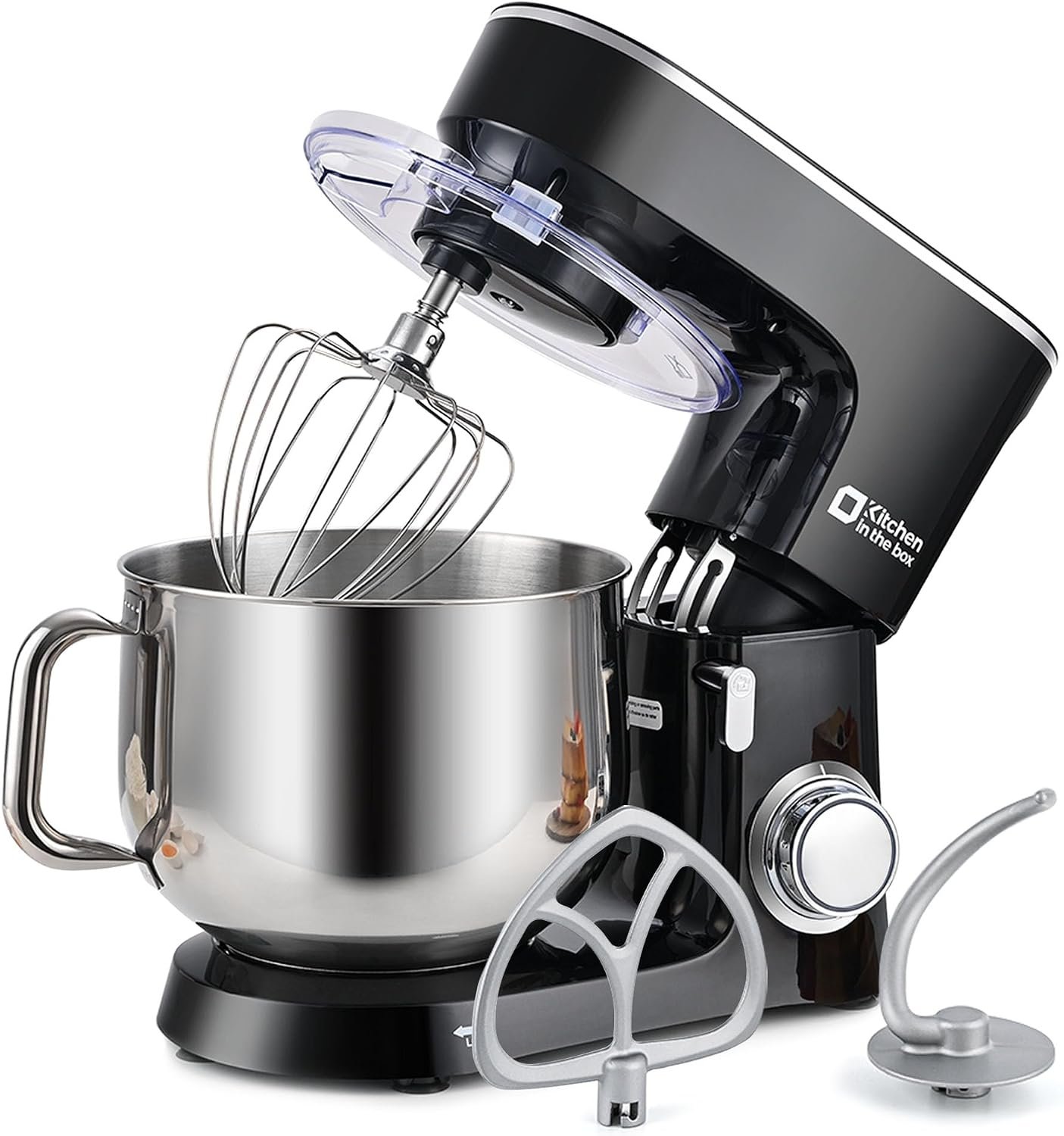
When you need a stand mixer that won’t flinch at bread dough or a double batch of cookie batter, wattage and bowl size are the numbers that matter most. The Kitchen in the box 8.5QT packs a 900-watt copper motor into a tilt-head design with an 8.5-quart stainless steel bowl — a combination that puts it firmly in the serious home baker category rather than the occasional-use bracket.
The 10-speed control with a pulse function gives you genuine range. Lower speeds (1–3) are suited to kneading stiff bread doughs, mid-range speeds handle cake batters, and the top end whips cream quickly. Three attachments — dough hook, flat beater, and whisk — cover the vast majority of mixing tasks without needing extras. The tilt-head design makes swapping attachments and adding ingredients straightforward.
The 8.5-quart bowl is large enough for family-scale baking: the brand positions it for two to six people, and the bowl dimensions back that up. Cleanup is handled by dishwasher-safe accessories, which is a practical time-saver after a full baking session.
The owner feedback pool is still relatively small compared to the compact sibling, so long-term durability data is limited. At its mid-range price, it represents strong value given the motor spec and bowl capacity, though buyers wanting decades of guaranteed service may prefer a heritage brand at a higher price point.
What Owners Say
Owners consistently praise the mixer’s performance relative to its price, with several noting it holds its own against pricier competitors. Early baking results — including scones and bread — draw positive comments. Because the review base is still building, there is not yet a strong pattern of negative feedback, though the limited sample size means long-term reliability remains an open question.
Pros
- 900-watt copper motor handles heavy doughs confidently
- 8.5-quart bowl suits family-scale and doubled recipes
- 10 speeds plus pulse offer fine-grained control
- All accessories and bowl are dishwasher-safe
- Tilt-head design makes bowl and attachment access easy
Cons
- Smaller owner feedback pool makes long-term durability harder to assess
- Large footprint (16.6" wide) requires dedicated counter or storage space
- No color variety noted — single deep-black option
Best for: Regular home bakers, families baking for 2–6 people, anyone tackling heavy or stiff doughs frequently Not for: Studio apartment dwellers with minimal counter space, or very occasional bakers who won't recoup the mid-range price
| Brand | Kitchen in the box |
|---|---|
| Color | Deep Black |
| Product Dimensions | 10.4"D x 16.6"W x 14.2"H |
| Material | Plastic, Stainless Steel |
| Special Feature | Adjustable Speed Control - 10 Speed, Better Kneading Heavy Dough, Large Capacity for the Whole Family - 8.5 Quart, Upgrade Powerful Motor 900 Watt, Whisking Cream at High Speed in Minute See more |
| Capacity | 8.5 quarts |
| Voltage | 120 volts |
| Wattage | 900 watts |
| Controls Type | Knob |
| Model Name | Stand Mixer |
2. Kitchen in the box 3.2Qt 300W — Best for Small Kitchens
Verdict: A lightweight, compact stand mixer with a 3.2-quart bowl that excels in tight spaces and suits solo bakers or small households — though motor longevity is a noted concern at this price tier.
The Kitchen in the box 3.2Qt is built around a specific problem: you want a stand mixer, but your kitchen is small, your storage is limited, and you don’t need industrial output. At under seven pounds with a footprint of roughly 13 by 7 inches, it genuinely fits where full-size mixers don’t. The tilt-head design and four anti-slip suction cups add a layer of practicality that you’d expect to pay more for.
The 3.2-quart stainless steel bowl and six-speed knob control cover everyday tasks — whipping cream, beating egg whites, mixing cake batter, and light doughs. The anti-splash lid is a small but appreciated detail that keeps your counter cleaner. Three attachments (aluminium dough hook and flat beater, stainless steel whisk) handle the standard range of mixing jobs. Multiple color options let it integrate into a styled kitchen rather than just sitting there.
The 300-watt motor is the honest constraint here. For occasional light baking it works well; owners consistently praise whipping performance. But for stiff bread doughs or prolonged heavy mixing sessions, the motor is working at or near its limit, and a minority of owners report early failure under those conditions.
As a budget-tier pick, it offers solid everyday value for the right baker — but set realistic expectations about what 300 watts can sustain over time.
What Owners Say
A large proportion of owners are happy with the mixer’s appearance and its performance on lighter tasks like whipping and gentle dough work. Several specifically praise how well it fits in small kitchens. However, there is a recurring thread of durability concern: some owners report the motor burning out within a month, and others mention the unit breaking after only a few uses — particularly under heavier mixing loads. Mixing performance on stiff doughs receives mixed assessments overall.
Pros
- Compact and lightweight — stores easily in small kitchens or cabinets
- Strong whipping and light mixing performance praised by many owners
- Six speeds cover a useful range of everyday tasks
- Multiple color options suit varied kitchen aesthetics
- Transparent anti-splash lid is a practical addition
Cons
- A notable minority of owners report early motor failure or burn-out
- 300-watt motor struggles with stiff or heavy doughs
- 3.2-quart bowl limits batch sizes for families or doubled recipes
- Durability feedback is inconsistent — some units are reported as fragile
Best for: Solo bakers, couples, apartment dwellers, and anyone who bakes lightly and needs to save counter or storage space Not for: Anyone planning to knead heavy bread doughs regularly, bake for more than two people, or rely on the mixer as a daily workhorse
| Brand | Kitchen in the box |
|---|---|
| Color | Black |
| Product Dimensions | 12.9"D x 7"W x 10.2"H |
| Material | ABS Plastic, Stainless steel, Aluminum |
| Special Feature | Dishwasher Safe accssories |
| Capacity | 3 liters |
| Voltage | 120 |
| Wattage | 300 watts |
| Controls Type | Knob |
| Item Weight | 7 pounds |
How They Compare
Both mixers come from the same brand and share design philosophy — tilt-head, knob control, three standard attachments — but they serve fundamentally different bakers. The 8.5QT 900W model offers three times the motor wattage and more than double the bowl capacity, which translates to a real-world difference for anyone mixing stiff doughs or large batches. Its owner satisfaction is also more consistently positive, though the review count is far lower. The compact 3.2Qt has a much larger feedback base and performs well on light tasks, but the durability concerns raised by a portion of owners are a genuine caveat at the budget price. If counter space is your primary constraint, the compact model makes sense; if you bake more than casually, the investment in the larger model pays off quickly in capability and reliability.
What to Look for in a Best Stand Mixer
Motor Wattage
Wattage determines what kinds of dough and batter the mixer can handle consistently, not just occasionally.
Look for: At least 600W for regular bread or pizza dough; 300W is workable for cakes, batters, and whipping only.
Avoid: Underpowered motors for heavy tasks — running a low-wattage motor at its limit is the most common cause of premature burn-out.
Bowl Capacity
Capacity sets a hard limit on batch size and directly affects how useful the mixer is for your household.
Look for: 3–4 quarts for 1–2 people doing light baking; 6+ quarts for families or doubled recipes.
Avoid: Buying the smallest bowl to save money if you regularly bake for more than two people — you will outgrow it quickly.
Speed Range and Control
More speed settings give you finer control across delicate and aggressive mixing tasks.
Look for: Six or more speeds with a clear low-end for kneading and a high-end for whipping; a pulse function is a bonus.
Avoid: Single-dial mixers with only 3–4 speeds if you bake a wide variety of recipes.
Durability and Build Materials
The motor housing, bowl, and attachment materials determine how long the mixer holds up under regular use.
Look for: Stainless steel bowl, metal or reinforced attachment hub, and positive owner feedback on multi-year use.
Avoid: All-plastic construction for heavy-use scenarios, and models where owner feedback shows consistent early failure patterns.
Footprint and Storage
A mixer that doesn't fit your kitchen will get put away and not used.
Look for: Measure your available counter or cabinet space before buying; check product dimensions, not just quart capacity.
Avoid: Assuming a larger bowl means a proportionally larger machine — check the actual width and height dimensions.
Best Stand Mixer Buying Guide
Why Wattage Matters More Than You Think
The most common stand mixer regret is underpowering. A mixer rated at 300 watts can whip cream and beat cake batter without complaint. Ask it to knead a stiff whole-wheat dough two or three times a week and you’re running it near its ceiling — which is exactly what owner feedback on budget models reflects when early failures are reported. A good rule of thumb: if bread is a regular item in your kitchen, look for 600 watts or above. If your baking is mostly cakes, cookies, and whipped elements, a lower-wattage compact model may genuinely be all you need.
Choosing the Right Bowl Size for How You Actually Bake
Bowl capacity is the best stand mixer specification that shoppers most often get wrong — usually by sizing down to save money. A 3-quart bowl works well for a single person or couple baking occasionally. Once you’re doubling recipes, baking multiple loaves, or feeding a family of four, a 3-quart bowl becomes a frustrating bottleneck. The 8.5-quart model reviewed here is at the generous end for home use — good if you batch-cook or bake for gatherings, but overkill if you make one cake every few weeks. Match the bowl size to your realistic, not aspirational, baking frequency.
Tilt-Head vs. Bowl-Lift: What You Need to Know
Both models in this guide use a tilt-head design, which is generally the friendlier choice for home bakers. The head pivots back to give you open access to the bowl for adding ingredients mid-mix or swapping attachments. Bowl-lift designs — common on commercial and semi-professional machines — lock the bowl into place and raise it into the attachment, which is more stable for very heavy loads but adds complexity. For the vast majority of home bakers, tilt-head is the practical and sensible default.
Attachments: What Comes in the Box and What You’ll Actually Use
Both mixers here include the three attachments that cover roughly 90 percent of home baking: a dough hook, a flat beater, and a wire whisk. The dough hook kneads yeasted doughs. The flat beater is your general-purpose tool for batters, frostings, and cookie doughs. The whisk handles whipped cream, egg whites, and anything that needs air incorporated. Check that attachments are dishwasher-safe — both models here are — because cleaning a wire whisk by hand after a meringue is not enjoyable. Beyond the standard three, many brands offer additional attachments (pasta rollers, meat grinders) but these are extras worth evaluating only after you’ve confirmed the base mixer suits your needs.
Counter Space and Storage: Measure Before You Buy
A stand mixer is not a small appliance. Even the compact 3.2Qt model reviewed here is nearly 13 inches deep. The 8.5Qt model is over 16 inches wide. Before any purchase, measure the space where the mixer will live — whether that’s on the counter or in a cabinet. Weight matters for storage too: under seven pounds is genuinely liftable for a single person; heavier full-size machines often end up as permanent counter fixtures by necessity. If you have limited space, the compact model’s lightweight design is a real practical advantage, not just a marketing angle.
How We Picked
Each product was evaluated by analysing published specifications alongside owner feedback patterns drawn from verified purchaser reviews. Motor wattage, bowl capacity, speed range, and included accessories were weighed against the type of baking tasks each mixer is marketed for. Where specifications made a claim — such as handling heavy dough — we cross-referenced that against the owner sentiment data to identify whether real-world results matched.
Ranking reflects a combination of owner satisfaction consistency, specification strength relative to price tier, and how well each model serves its stated target audience. Products with a larger review base were given additional weight on durability assessments; those with fewer reviews were noted accordingly. No physical testing was conducted; all conclusions are drawn from documented specs and aggregated buyer experience.
Frequently Asked Questions
What is the best stand mixer for bread dough?
For regular bread baking, prioritise a motor of at least 600 watts and a bowl large enough for your batch size. Between the two models reviewed here, the 900-watt 8.5QT option is the clear choice for bread dough — it has the power to knead stiff doughs without stressing the motor, and the larger bowl handles standard loaf recipes comfortably.
Is a 300-watt stand mixer powerful enough?
For light tasks — whipping cream, beating eggs, mixing cake batter — 300 watts is usually adequate. For kneading bread or pizza dough regularly, it is marginal at best. Owner feedback on the compact 300-watt model here shows it performs well on lighter tasks but draws complaints when pushed into heavy dough territory. Use it within its limits and it can last well; push it hard and you risk early wear.
What stand mixer bowl size do I need?
For one to two people baking occasionally, a 3–4 quart bowl covers most recipes. For a household of three or more, or if you regularly double recipes, aim for six quarts or above. The 8.5-quart bowl reviewed here suits families and batch bakers well. A bowl that’s too small is more limiting than one that’s slightly too large.
Are stand mixer attachments interchangeable between brands?
Generally, no. Stand mixer attachments are not universal — they are designed to fit the specific hub and bowl dimensions of their own brand and model line. Before buying extra attachments, confirm they are designed for your exact model number. Both mixers reviewed here include the three core attachments (dough hook, beater, whisk) that handle the large majority of home baking tasks.
How do I clean a stand mixer?
Most modern stand mixers have dishwasher-safe accessories — both models here do — which makes cleanup straightforward. Wipe down the mixer head and body with a damp cloth; never submerge the motor housing in water. Remove and wash attachments after each use to prevent dried batter build-up. The tilt-head design on both models here makes it easy to access the bowl and attachments without awkward manoeuvring.
Final Thoughts
If you bake regularly and want a stand mixer that handles everything from bread doughs to large cake batches, the 8.5QT 900W model is the stronger, more confident choice. If you have a small kitchen, bake lightly, and need something easy to store, the compact 3.2Qt delivers solid everyday value — just keep it within its power limits. Either way, matching the mixer to your actual baking habits, not your aspirational ones, is the decision that matters most.
- Choose by wattage first — your dough type determines the motor you need more than any other single specification.
- Size down only if storage is a genuine constraint and your baking is light; undersizing a bowl is one of the most common regrets.
- The 8.5QT 900W model earns its place as the best stand mixer here for most home bakers, while the compact model is a legitimate pick for small-space, low-intensity use.
Picking the best stand mixer comes down to an honest conversation with yourself about how and how often you bake. The 900-watt 8.5QT mixer reviewed here is the more capable and consistently rated option — a solid investment if baking is a regular part of your kitchen life. The compact 3.2Qt earns its place for small kitchens and lighter use, provided you respect the limits of its motor. Buy to your real habits, check the dimensions before you order, and either of these will serve you well.